
What is motorcycle valve clearance?
Valve clearance is a tiny but critical gap in your engine. Here's why it matters, how to check it, and when to adjust it.
If you’ve ever heard a metallic ticking sound when starting your bike cold, or if your mechanic has mentioned “valve clearance” while handing you a bill, don’t worry. Behind this technical-sounding term lies a simple concept and a maintenance task that’s critical to your engine’s health. Here’s everything you need to know, even if you’ve never cracked open a valve cover.
What do valves actually do in a motorcycle engine?
To understand valve clearance, you first need to know what valves do. They’re mushroom-shaped metal components that open and close at high speed inside the cylinder head. Think of them as gatekeepers: intake valves let the air-fuel mixture into the cylinder, and exhaust valves push the burnt gases out after combustion.
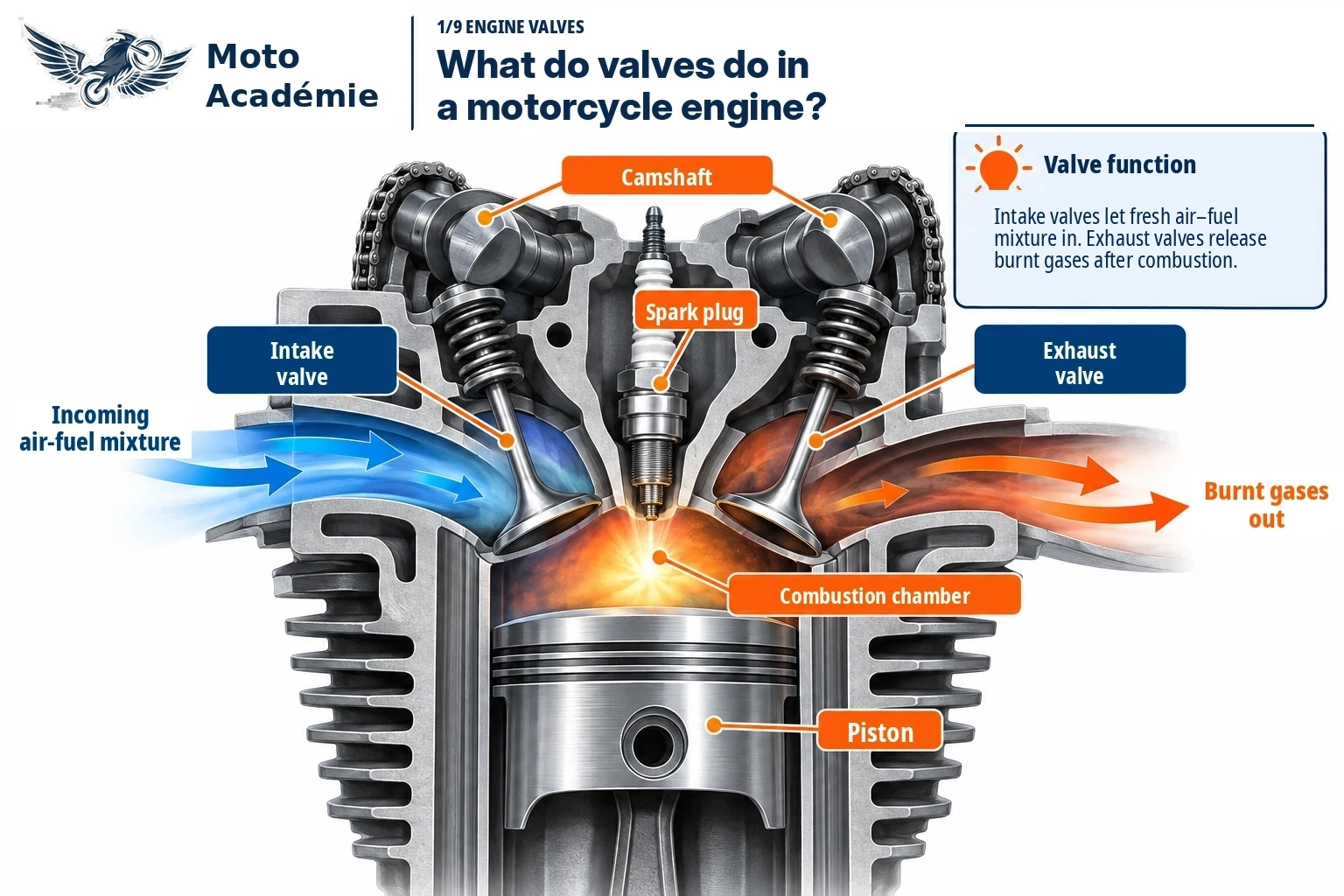
On a four-stroke engine (which powers the vast majority of road bikes), each cylinder typically has 2 to 4 valves. A four-cylinder sportbike can have 16 valves in total. They open and close dozens of times per second, driven by the camshaft through rocker arms, finger followers, or bucket tappets.
What exactly is valve clearance?
Valve clearance is a small, deliberate gap measured in fractions of a millimeter between the top of the valve stem and the component that operates it (cam lobe, rocker arm, or tappet). This gap is intentional and essential.
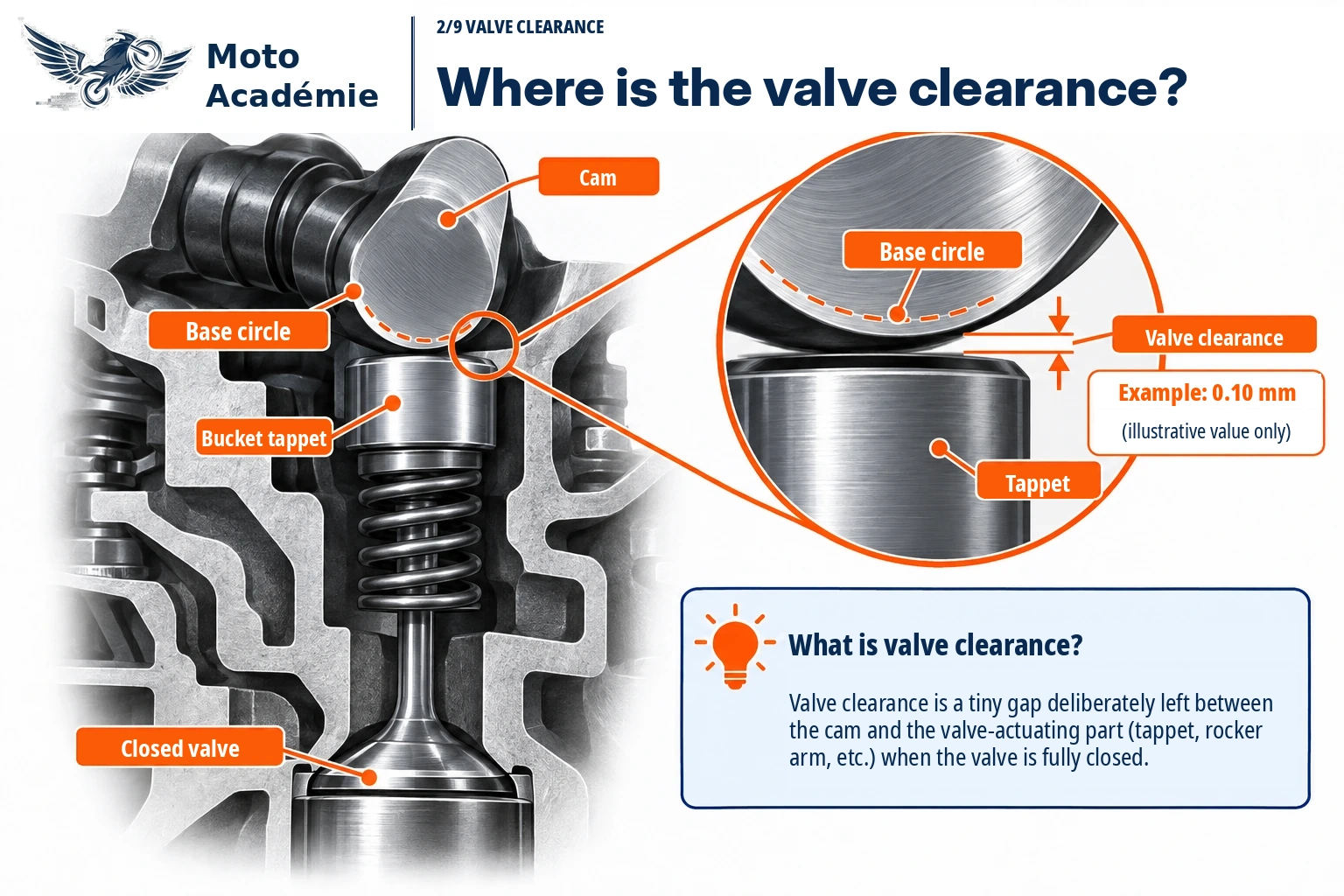
Why? Because your engine gets extremely hot. Combustion gases can reach 1,500 to 2,000 °C at full load, and exhaust valves typically run at around 600 to 850 °C depending on the engine. Metal expands and valves grow longer. If everything were perfectly tight when cold, the valves wouldn’t fully close once the engine reaches operating temperature. That tiny gap compensates for this thermal expansion.
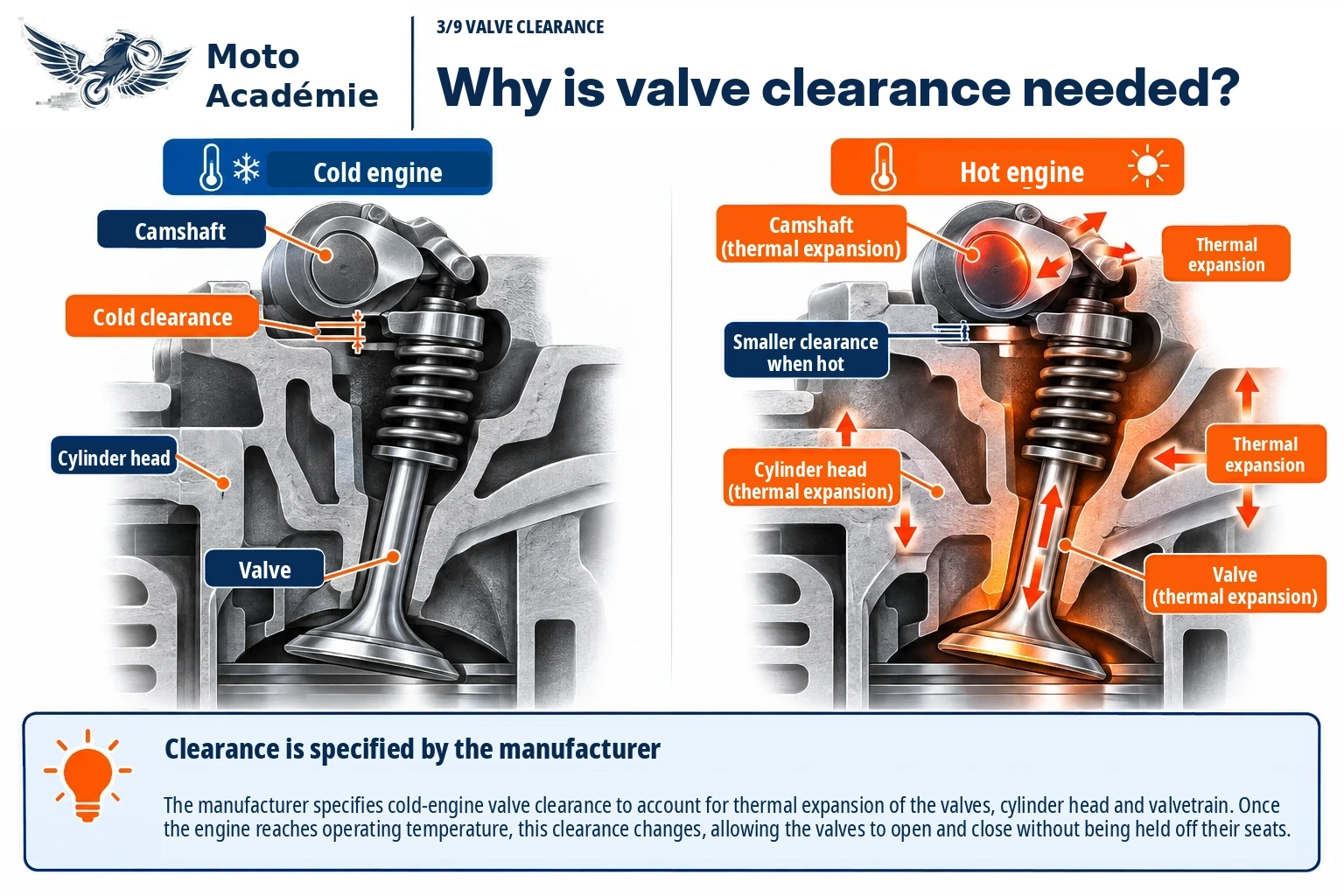
Typical clearance values are very small: generally between 0.05 and 0.30 mm depending on the engine. Intake valves usually have tighter clearances (for example 0.10 mm) than exhaust valves (for example 0.20 mm), because exhaust valves are exposed to much higher temperatures and expand more.
What happens when valve clearance is wrong?
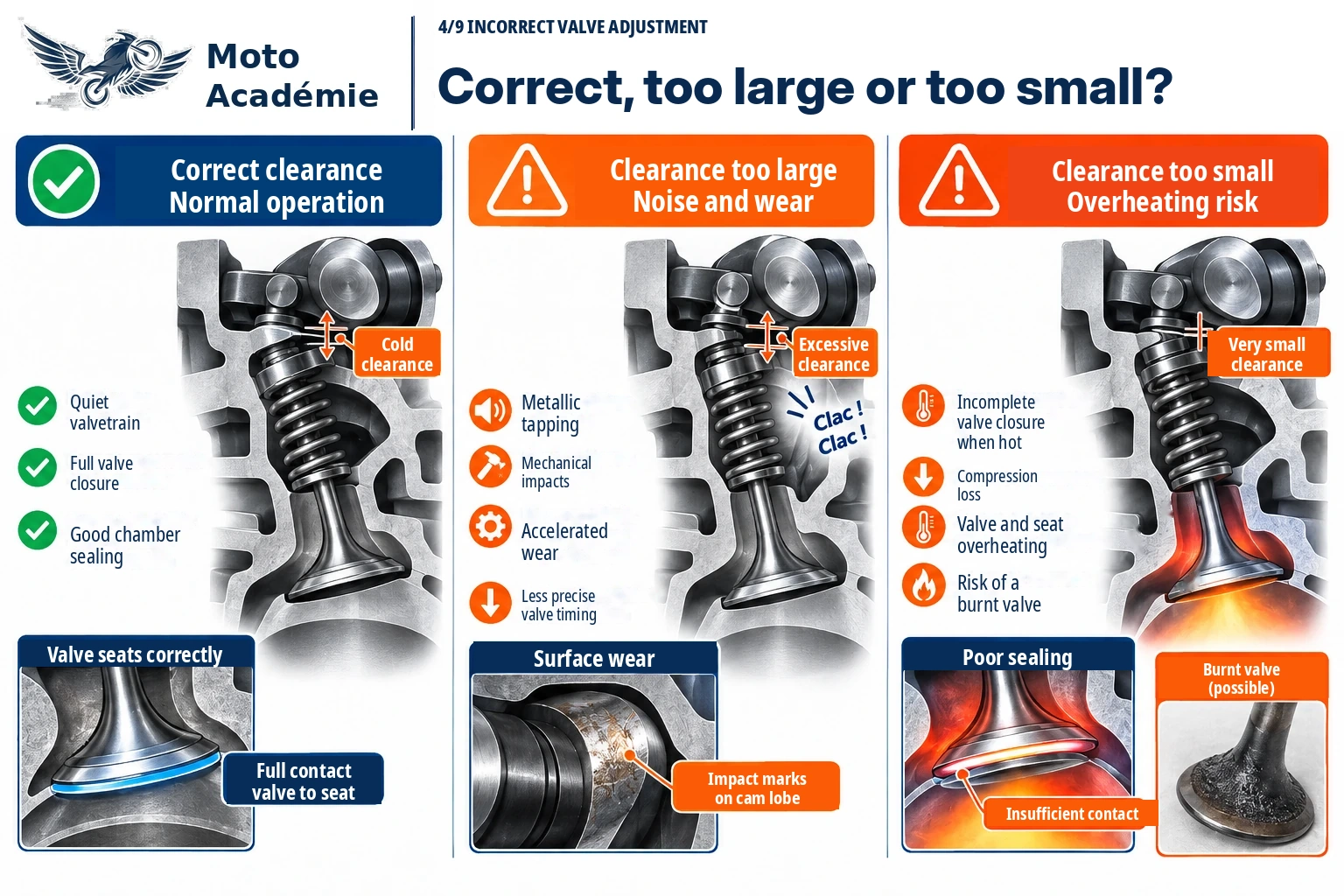
Valve clearance outside the manufacturer’s specification is the beginning of trouble. The consequences differ depending on whether the gap is too large or too small.
Clearance too large
If the gap is too wide, the cam hammers against the valve instead of actuating it smoothly. You’ll hear a distinctive metallic tapping, especially when cold. Over time, this repeated impact causes premature wear on the valve stem, rocker arm, and cam. The engine also loses performance because the valve doesn’t stay open long enough (reduced lift duration).
Clearance too tight or zero
This is the more dangerous scenario. If the clearance is too tight, the valve can’t fully close when the engine is hot. The result: burning-hot gases leak past the valve, the engine loses compression, and the valve overheats because it can’t transfer its heat to the valve seat. This can lead to a burnt valve and irreversible compression loss, in other words, engine failure.
Exhaust valves are the most vulnerable: they’re exposed to the hottest gases and are the first to go out of spec.
Common symptoms of incorrect clearance
Watch for these warning signs: excessive metallic ticking at idle (too much clearance), cold starting difficulties, gradual power loss, unstable idle, or increased fuel consumption. When in doubt, a clearance check is the best approach.
How is valve clearance checked?
The check is always performed with the engine cold (ideally after sitting overnight), because the measurement relies on parts being in their non-expanded state.
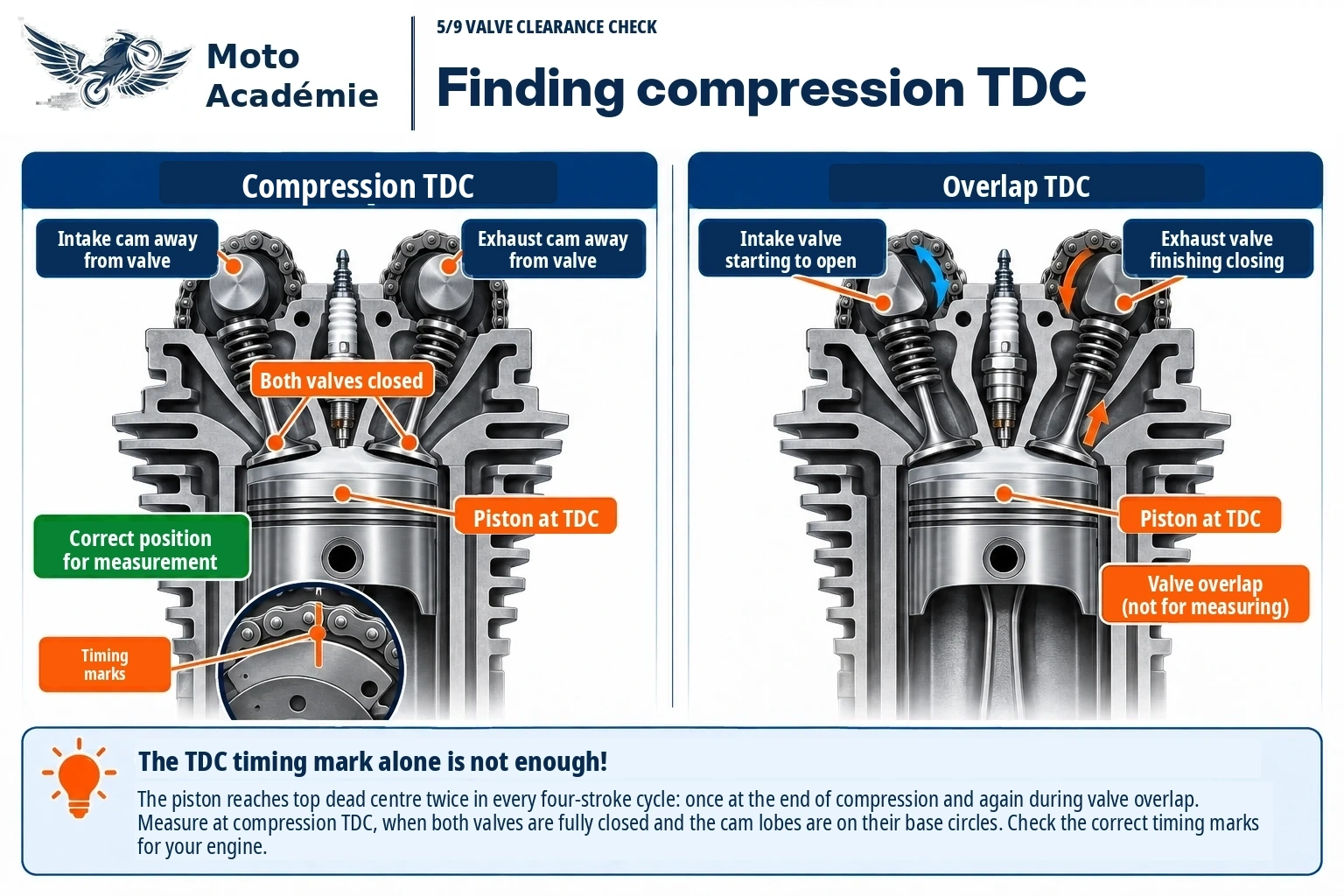
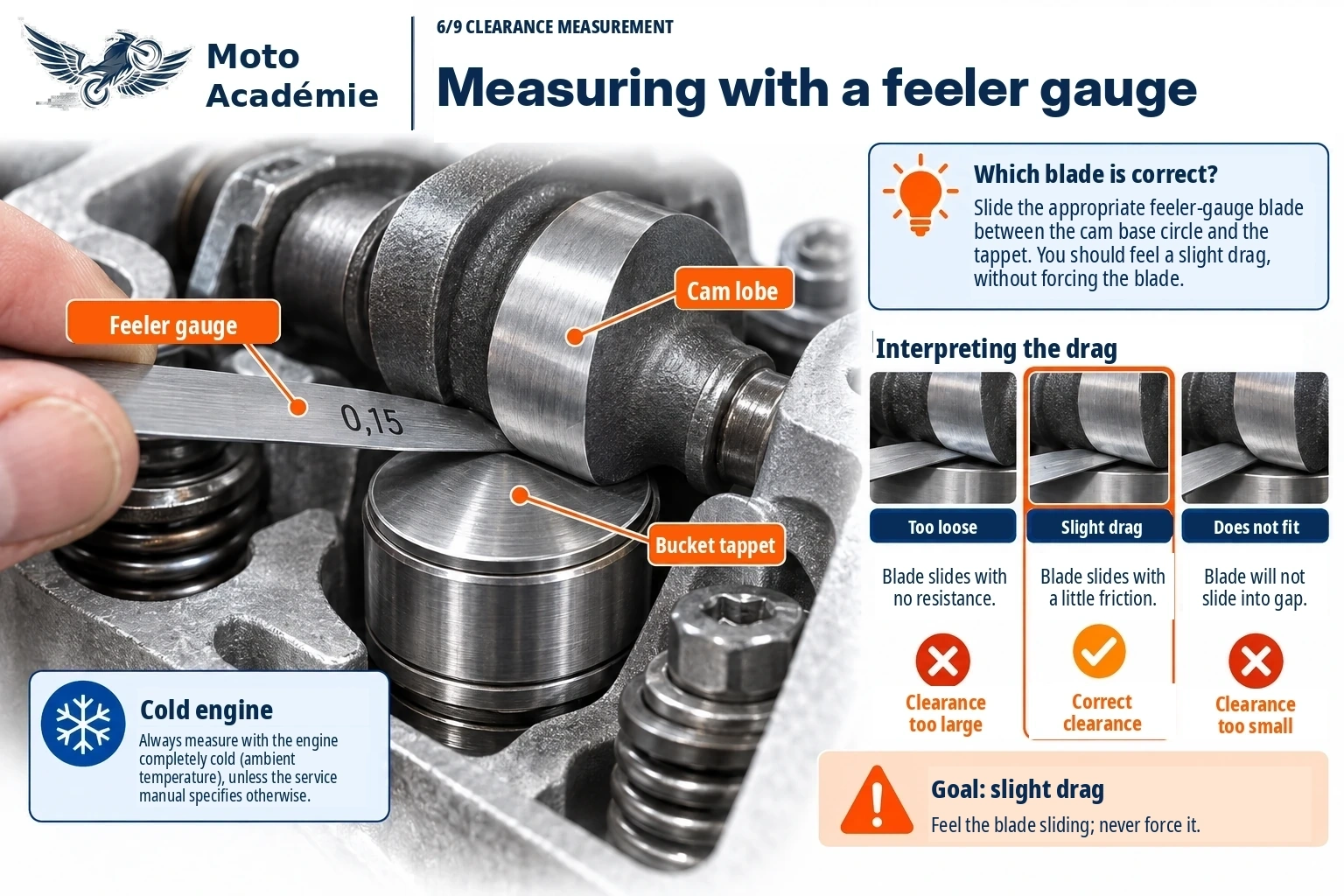
The principle is straightforward: position the piston of the cylinder you’re checking at Top Dead Center (TDC) on the compression stroke (both valves closed), then slide a feeler gauge (a set of calibrated metal blades) between the valve stem and the actuating component. If the gauge matching the manufacturer’s spec slides in with slight resistance, the clearance is correct. If it slides in too easily or won’t fit, adjustment is needed.
To find TDC on the compression stroke, you align timing marks on the flywheel or crankshaft (look for the “T” mark on many Japanese bikes). The camshaft timing marks must also be correctly positioned.
What are the adjustment methods?
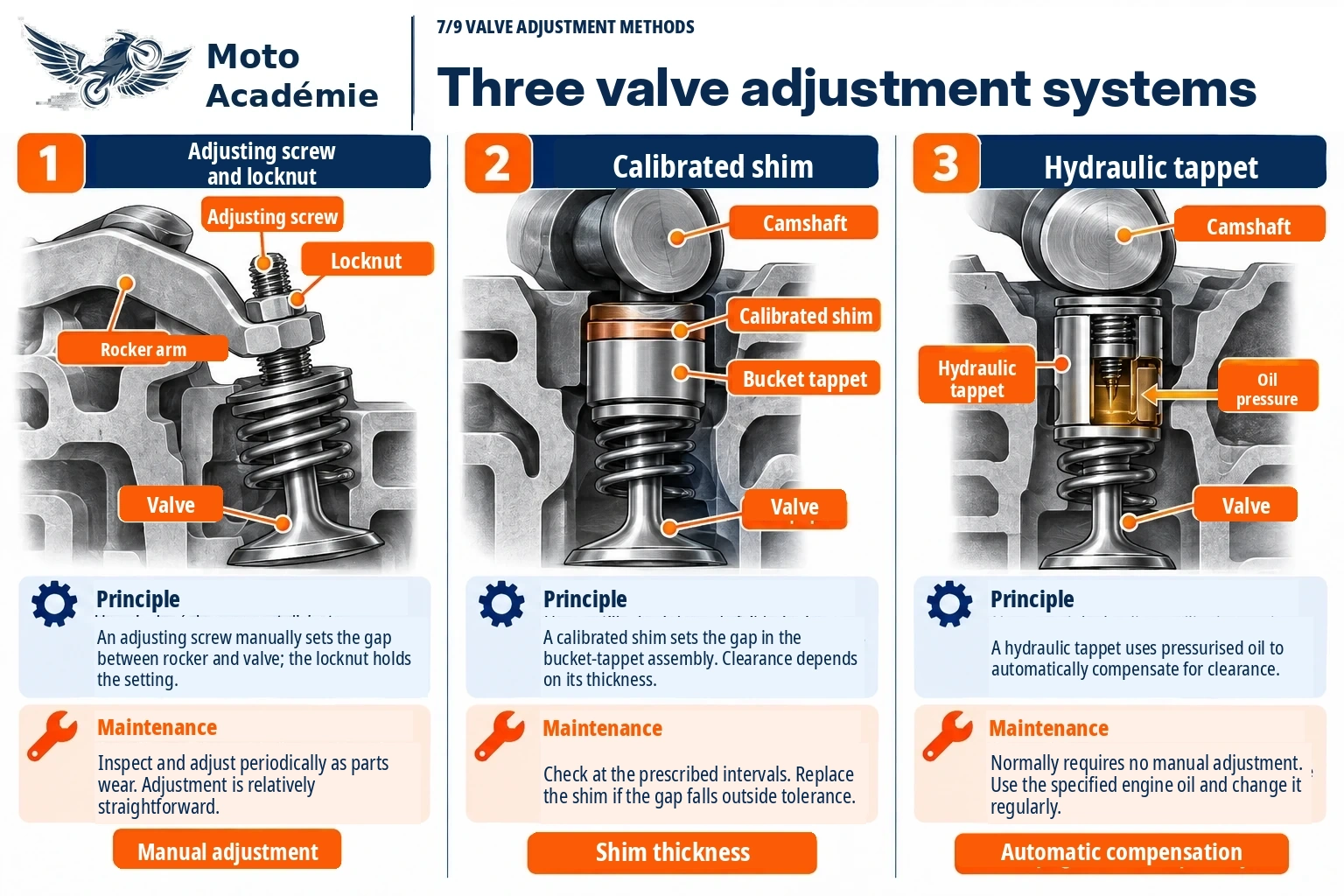
There are three main systems, and the method depends on your motorcycle.
Screw and locknut
This is the simplest and oldest system. You loosen the locknut, turn the adjusting screw to achieve the correct gap, then retighten the locknut while rechecking. It’s found on many singles, dual-sports, and entry-level bikes. The job is manageable with basic tools: a spanner, an Allen key, and a set of feeler gauges.
Calibrated shims
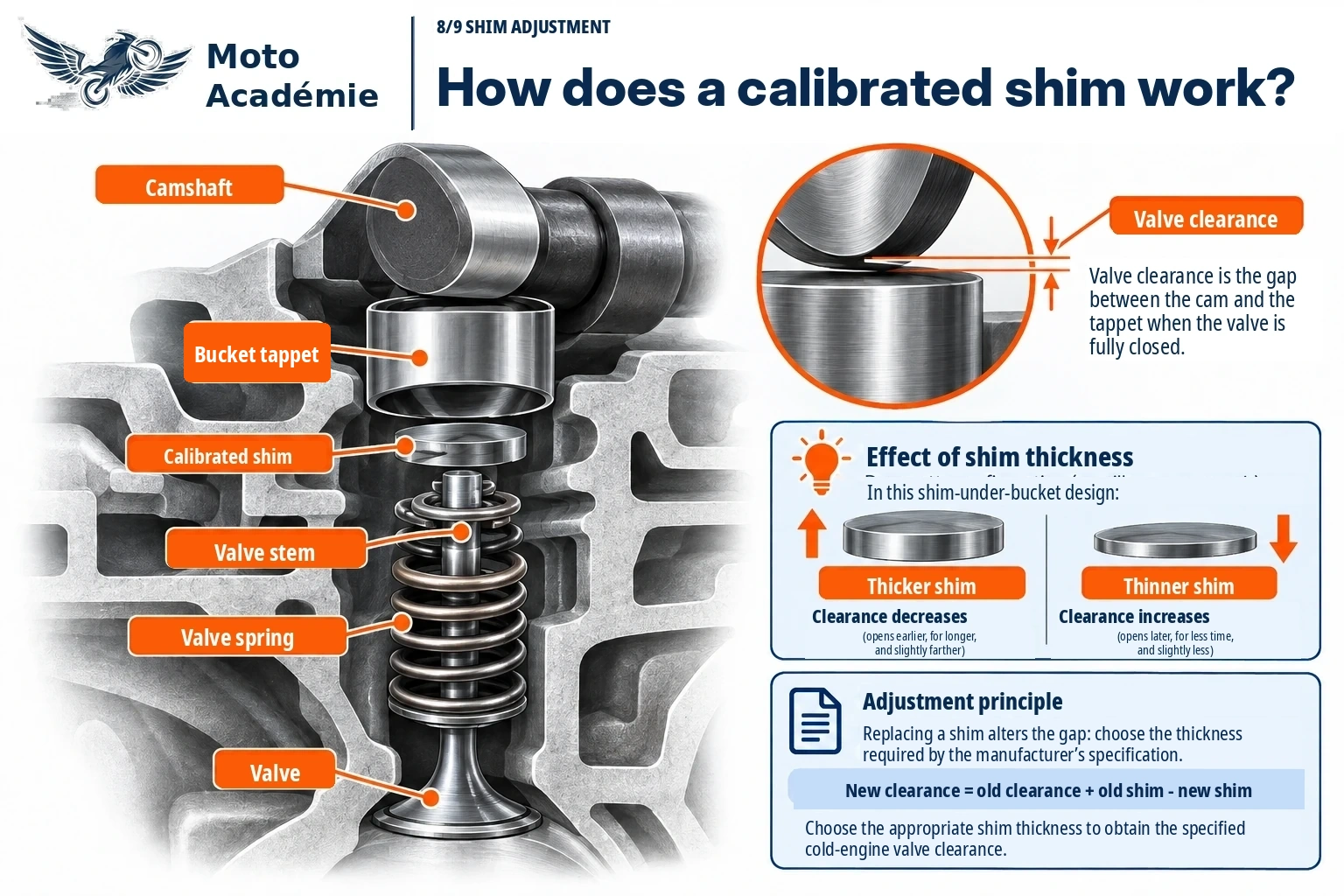
This is the most common system on sportbikes and modern multi-cylinders. Shims of varying thicknesses sit between the cam and the bucket tappet (shim-over-bucket) or underneath it (shim-under-bucket). To change the clearance, you swap the shim for a thinner or thicker one. It’s more time-consuming because you often need to remove the camshaft to access the shims. Each shim costs around $8 to $15, and a four-cylinder engine has 16 of them.
Hydraulic tappets
This system adjusts clearance automatically using oil pressure. It’s mainly found on certain cruisers (Harley-Davidson, for example). The advantage: no manual adjustment needed. The drawback: the system is heavier, which limits maximum engine RPM. That’s why high-revving sportbikes don’t use hydraulic tappets.
How often should valve clearance be checked?
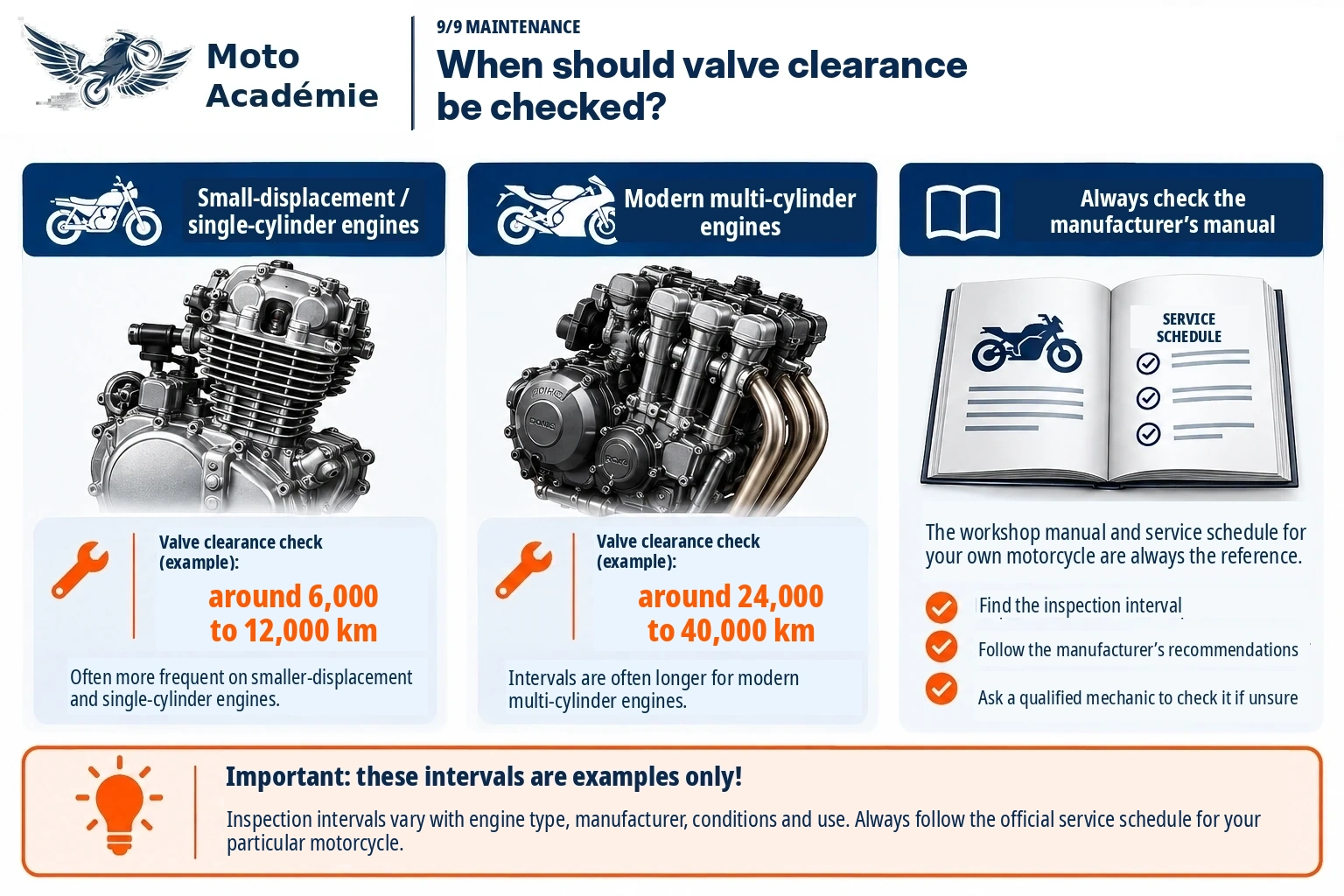
It depends entirely on your motorcycle. Intervals vary significantly between manufacturers and models. Some general guidelines: small-displacement singles often require a check every 4,000 to 8,000 miles (6,000 to 12,000 km). Modern multi-cylinders with calibrated shims typically hold up for 15,000 to 25,000 miles (24,000 to 40,000 km), sometimes even longer on certain Hondas, which are known for exceptional valve train stability.
The only reliable reference is your bike’s service manual. The values and intervals are clearly listed there. If you’re buying a used bike with no maintenance records, a valve clearance check should be high on your priority list.
How much does a professional adjustment cost?
The cost varies depending on engine type and adjustment system. Expect to pay between $200 and $500 at a dealer for a multi-cylinder shim-type engine (1.5 to 4 hours of labor). Screw-and-locknut systems are faster and therefore cheaper. If you’re handy and have a good workshop manual (Haynes, Clymer, or the factory service manual), it’s a job you can do at home with a set of feeler gauges and basic tools.
Wrapping up
Valve clearance is that tiny, precisely calculated gap that keeps your engine running properly whether cold or hot. Too much clearance creates noise and wear, too little can destroy a valve and your engine. It’s a maintenance item that’s easy to forget about, but it’s essential for your motorcycle’s longevity and performance. If you’re unsure, a simple check with a set of feeler gauges will tell you exactly where things stand.